
Automated traffic enforcement programs are often evaluated on their technology: camera resolution, detection accuracy, integration with traffic management systems. But the agencies that have operated these programs for a decade or more will tell you something different. The hardware is the easy part. The operational infrastructure — citation processing, legal defensibility, public communication, data governance, and staffing continuity — is where programs succeed or collapse.
For DOTs in states now evaluating or expanding ATE authority, understanding the full operational picture before awarding a contract is not just prudent. It is essential to long-term program health.
A Camera Is the Start, Not the Solution
When a jurisdiction authorizes automated speed or red-light enforcement, the most visible public criticism tends to focus on camera placement and the perception that citation volume is the goal, not safety — but operational scrutiny, including questions about reporting accuracy and data integrity, is never far behind. Yet the layered back-office operation that determines whether a program can withstand that scrutiny — citation processing, data governance, adjudication readiness — is rarely part of the public conversation unless something goes wrong.
According to the FHWA and NHTSA Speed Safety Camera Program Planning and Operations Guide, a well-structured program must explicitly address the following operational dimensions:
- 24/7 image review and citation approval workflows that meet state-specific legal standards
- Trained adjudication staff capable of handling contests, exemptions, and due process requirements
- Registered owner lookup through DMV partnerships across multiple states
- Multilingual, accessible violation notice design and public-facing communications
- A customer service infrastructure that can handle inbound inquiries at scale
- Secure, auditable data storage with chain-of-custody documentation for court proceedings
- Reporting systems that satisfy legislative transparency mandates and public records obligations
Each of these functions requires dedicated personnel, process design, and quality control. Most state DOTs are not staffed to absorb these workloads internally, nor should they be. Choosing an experienced vendor partner isn’t about convenience — it’s about whether a program can hold up under legal challenge, media scrutiny, and sustained operational pressure.
The Staffing Gap No One Plans For
State DOTs are infrastructure agencies. Their core competencies such as roadway design, maintenance, traffic operations do not naturally include high-volume administrative enforcement. When a DOT launches an ATE program without a fully scoped operational partnership, one of several predictable failure modes tends to emerge.
Underestimating citation volume
Work zone speed enforcement programs, in particular, can generate thousands of reviewable violations per month during active construction seasons. A single high-volume corridor can exceed the processing capacity of existing agency staff within weeks of launch. Programs that start strong often accumulate backlogs that erode legal defensibility and create public trust problems when violation notices arrive long after the incident.
Adjudication unpreparedness
Every contested citation is a test of the program itself. Agencies unprepared with certified technician documentation, chain-of-custody records, and calibration logs risk losing not just individual cases, but facing court orders that pause entire programs. Experienced operators maintain these records systematically, and it simply is not a documentation practice that can be retrofitted after the fact.
Choosing hardware over operational expertise
The most technically impressive camera system cannot process a contested citation, respond to a public records request, or produce the documentation a court requires. Programs that prioritize hardware specifications in vendor selection — without equally rigorous evaluation of back-office capacity — often discover that gap only after a program is live and under pressure. Agencies should ask not just whether a vendor can deploy the technology, but whether they have run this type of program, at this scale, under a comparable legal and regulatory framework.
What Mature Program Operations Look Like in Practice
Jurisdictions with long-tenured ATE programs provide a useful blueprint. The Maryland State Highway Administration’s work zone speed enforcement program, for instance — one of the longer-running state DOT programs in the country — operates with back-office staffing scaled to corridor count, seasonal enforcement calendars aligned to active construction, and reporting infrastructure that supports annual legislative reviews. That operational depth did not materialize at launch. It was built through years of program iteration with a vendor partner that treated operational capacity as a shared responsibility.
Across Maryland, where speed, red-light, and work zone programs operate across multiple jurisdictions, and in programs like Wilmington, Delaware’s red-light enforcement, sustained multi-cycle operation reflects back-office infrastructure designed for longevity, not just launch.
For newer programs, particularly those in states where ATE authorization is recent and the regulatory framework is still developing, the vendor selection decision is also an operational infrastructure decision. Choosing a vendor without demonstrated back-office capacity in the relevant program type — work zone, school zone, or red-light — means the agency absorbs that operational risk directly.
What to Evaluate Beyond the Technology Proposal
When DOTs reach the shortlisting stage, RFP evaluation criteria often weight hardware specifications, detection accuracy, and system integration heavily. Operational capacity frequently receives less structured scrutiny. The following questions can surface meaningful differentiation between vendors:
- How does your citation review staffing scale with corridor expansion or seasonal volume increases?
- What is your average time-to-notice from violation capture, and what factors affect it?
- What multilingual and accessibility standards do your violation notices and public communications meet?
- Describe your adjudication support process — specifically, what documentation you maintain and how it is produced for hearings.
- How do you handle registered owner lookup for out-of-state vehicles, and what is your resolution rate?
- What transparency reporting do you produce, and how is it structured for legislative or public records purposes?
- Walk us through your program transition process — what does continuity look like if this contract ends?
Vendors with genuine operational depth will answer these questions with specificity. Vendors whose competency lives primarily in hardware will struggle. That gap, surfaced at the shortlisting stage, is far less costly than discovering it after a program is live.
A Growing Number of States Are About to Face These Questions for the First Time
Across the country, state legislatures are actively expanding or newly authorizing automated traffic enforcement. Work zone automated enforcement bills, school zone speed enforcement expansions, and red-light camera authorization measures are moving through multiple chambers simultaneously. For the DOTs that will be tasked with implementing these programs, the operational planning conversation needs to start well before the first RFP is issued.
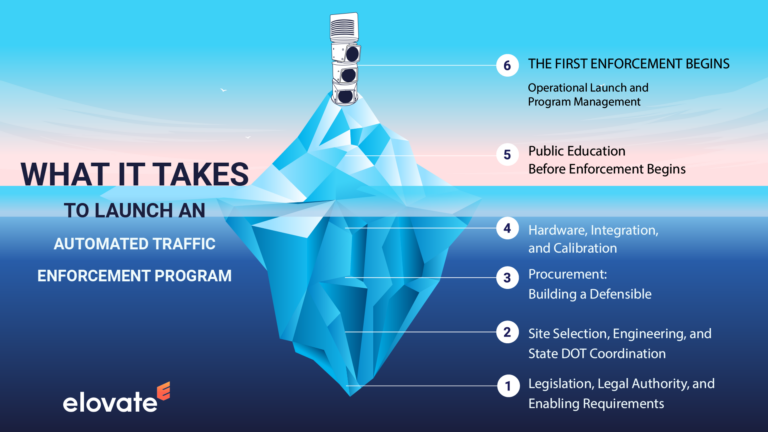
States that have recently passed ATE legislation — or where such legislation is advancing — tend to underestimate implementation timelines. Standing up a legally defensible, operationally sound program typically takes six to twelve months from authorization to first citation. That timeline is driven not only by permitting and construction but in large also by back-office readiness: DMV access agreements, notice design approvals, adjudication procedure development, and staff onboarding. Agencies that engage vendor partners early in the legislative process, before a law is finalized, are consistently better positioned to launch on time and under scrutiny.
Responsible vendors — those with program-type-specific expertise rather than generalist technology platforms — can serve as implementation planning partners during this pre-authorization window. That early engagement shapes procurement documents that reflect operational reality, not just equipment specs.
Compensation Structures Matter Too
One operational dimension that deserves attention at the shortlisting stage is vendor compensation structure. What matters less than the specific model — which may be shaped or mandated by state law — is whether the structure is transparently disclosed and creates clear vendor accountability for program performance. Agencies should understand exactly how their vendor gets paid, and ensure the contract includes performance standards that apply regardless of compensation model. This is not a theoretical concern — several states have faced legislative challenges to ATE programs specifically on the grounds that compensation arrangements lacked transparency or created the perception of a revenue incentive. Agencies entering new program authorizations should ensure their procurement language makes the compensation structure explicit and demonstrates clear alignment with safety goals.
What This Means For Your Program
The programs that last are not the ones that launched with the best hardware. They are the ones that were built to be challenged — by courts, by councils, by constituents — and had the operational infrastructure to hold up every time. That means citation records that survive cross-examination, notices that reach every registered owner, public inquiries that get answered, and reporting that leaves nothing open to question.
That level of readiness does not happen by accident, and it does not come from a vendor whose core competency is technology deployment. It comes from years of program-type-specific experience, applied before the first camera goes live. For agencies piloting an ATE program for the first time, the most important question at the shortlisting stage is not which vendor has the shinest equipment — it is which vendor has built this before, and can prove it.
Contact Elovate to discuss program readiness
Frequently Asked Questions
Beyond camera hardware, ATE programs require citation review staffing, registered owner lookup through DMV partnerships, adjudication documentation, multilingual violation notices, customer service capacity, and auditable data storage. These functions must be operational before the first citation is issued.
Typically, six to twelve months, depending on DMV access agreements, notice design approvals, and adjudication procedure development. Agencies that engage vendor partners early in the legislative process — before authorization is finalized — are consistently better positioned to launch on schedule.
Compensation structures that tie vendor payment exclusively to citation volume can expose programs to legislative and legal challenge by creating a perceived revenue incentive. Hybrid models that link vendor payment to a combination of program activity and measurable outcomes better align vendor and agency interests, and are more defensible under public and political scrutiny.