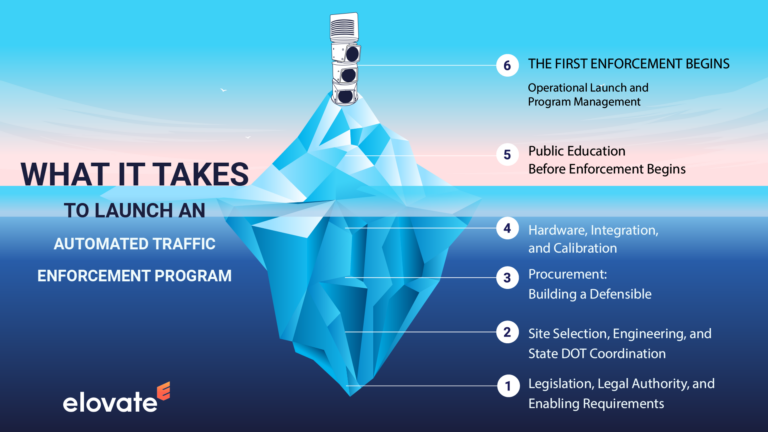

Automated traffic enforcement is infrastructure, and the jurisdictions that treat it that way build stronger, longer-lasting programs. When a speed or red-light program is scoped like a capital asset rather than a line-item service buy, decision-makers plan for the full lifecycle: the technology in the field, the back-office operations behind every citation, the data governance that protects the public, and the years of maintenance and evolution that follow. That mindset shift, from procurement transaction to capital investment, is where durable safety outcomes come from.
Why enforcement behaves like infrastructure
Think about how a city accounts for a bridge. The steel and concrete are what people see, but the real asset is everything that keeps it standing: the engineering behind it, the inspection schedule, the maintenance funded across decades. Automated traffic enforcement works the same way. The camera at the school zone is the visible piece, but it is a small part of what actually makes a program work.
What separates a strong program from a fragile one is everything around the hardware: careful site selection tied to crash data, defensible citation review, secure evidence handling, transparent public reporting, and the staffing to run all of it consistently. Those are capital-planning concerns, not accessories to a device purchase.
Treating enforcement as infrastructure also reframes the timeline. Capital assets are planned for the long term, funded across their full life, and evaluated on the outcomes they deliver over years. A program scoped this way asks the right questions up front: How will sites be selected and relocated as conditions change? How is data retained, purged, and audited? Who is accountable for uptime and accuracy? Those answers are far cheaper to build in at planning than to address later.
What a capital-planning frame changes in procurement
Most enforcement procurements are written as service contracts, and that framing narrows the decision to the equipment itself. A capital-planning frame reopens it to the full asset. For a procurement officer, that means judging a proposal on the whole program it delivers over years — operations, governance, accountability — not just the technology, and writing an RFP that can tell the difference between supplying equipment and operating a program end to end.
The distinction matters because the risk in these programs is operational, not mechanical. The technology in the field is the easiest part to match; nearly any proposal can put working equipment on a pole. What distinguishes a strong program is the operation behind it: citation review that holds up in court, data practices that earn public trust, and compensation structured with no perceived revenue motive. A capital lens brings those factors onto the evaluation table where they can be scored.
It also clarifies the money. Responsible programs are built around behavior change, using compensation structures where vendor payment is not tied to citation volume. Framed as infrastructure, the program is judged on the safety outcome the asset delivers over its life, not the citations it generates in a quarter. That is a far easier program to defend before a council or a skeptical public.
Data governance is part of the asset
A capital-planning conversation surfaces something service procurements often miss: the data an enforcement program produces is itself a long-lived asset that has to be governed for its full life. Retention schedules, automated purging, access restrictions by user role, and the ability to produce an audit trail on demand are not features to bolt on after go-live. They are design requirements that belong in the plan, because they are frequently the first thing community advocates and oversight bodies ask about.
Jurisdictions that scope governance early tend to face far less friction later. Clear public reporting and defensible data handling are what convert a program from a point of controversy into a piece of civic infrastructure the community understands and trusts.
The planning window is open in new states
North Carolina is a useful example of why the capital-planning frame matters now. With Senate Bill 391 (S.L. 2025-47), effective October 1, 2025, cities and counties across the state are authorized to deploy automated speed enforcement in school zones, with each municipality activating through a local ordinance. That is a green field, and green fields reward planning.
North Carolina also illustrates why lifecycle thinking is non-negotiable there specifically: the state constitution directs the clear proceeds of civil penalties to local school systems, which makes a volume-neutral, behavior-focused program design not just good practice but structurally necessary. Jurisdictions that scope their programs as safety infrastructure aligned with that requirement, rather than as a citation-generating service, will build programs that hold up politically and legally. The window to plan it correctly is open before the first camera is ever specified.
The same logic extends to any emerging market. The jurisdictions that will run the strongest programs a decade from now are the ones treating today’s authorization as the start of a capital project, not a shopping trip.
What longevity looks like
The programs that endure are the ones built on operational depth from the outset. Elovate’s longest partnerships, including a decades-long relationship with the Maryland State Highway Administration, and newer statewide work such as Virginia’s program, share the same foundation: enforcement scoped and run as durable infrastructure, with the back-office operations, governance, and accountability planned for the long haul. That is what a capital-planning frame is designed to produce.
Why this matters
Enforcement scoped as a quick service buy behaves like one: brittle, contested, and short-lived. Enforcement scoped as infrastructure behaves like infrastructure: planned, funded, governed, and built to deliver safety outcomes for years. As more states open the door to automated enforcement, the jurisdictions that bring ATE into their capital planning conversations early will be the ones whose programs still stand, and still save lives, long after the ribbon is cut.
Calculate the potential safety impact of traffic enforcement using our ATE impact calculator tool
Frequently Asked Questions
Both elements exist, but the strongest programs are planned as capital investments. The hardware is minor; the lasting value is in operations, data governance, and multi-year stewardship, which is why lifecycle capital planning produces more durable, defensible programs than a service-only procurement.
Yes. Under Senate Bill 391 (S.L. 2025-47), effective October 1, 2025, North Carolina cities and counties are authorized to deploy automated speed enforcement in school zones. Each municipality activates its program by passing a local ordinance.
Budget for the full lifecycle: technology, back-office operations, data retention and auditing, public reporting, and ongoing maintenance and site relocation. Compensation should be structured so vendor payment is never tied to citation volume, keeping the program focused on safety outcomes.