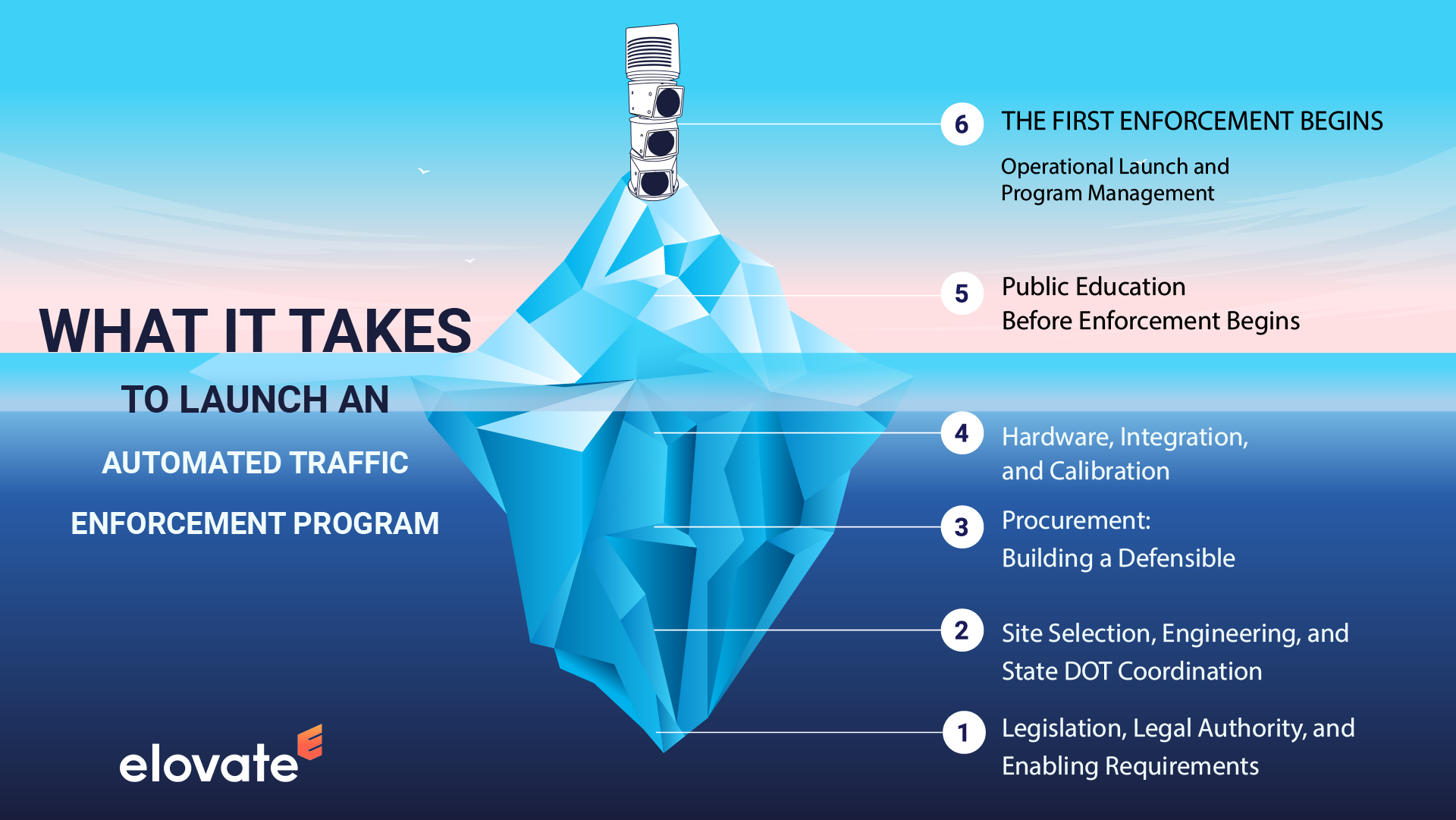
When Virginia State Police launched its statewide work zone speed enforcement program in early 2026, the cameras were the last thing to deploy. The legal framework, site coordination with VDOT, competitive procurement process, and public education campaign came first — by design. That sequence isn’t unique to Virginia. It’s the blueprint every successful Automated Traffic Enforcement program (ATE) follows, and having the right partner to guide it makes the difference between a program that earns community trust for decades and one that never makes it past year one. For jurisdictions considering their first ATE deployment, this guide walks through what that blueprint actually looks like, and what it takes to execute it well.
The Mistake Most First-Time Programs Make
Many jurisdictions approach automated enforcement as a hardware procurement problem. They identify a corridor, issue an RFP for equipment, and assume the vendor relationship will handle the rest.
That assumption is costly.
Municipalities that treat ATE as a camera-and-software purchase — rather than a full-lifecycle public safety program — routinely encounter delays, legal challenges, community backlash, and compliance failures that could have been prevented. Programs across the mid-Atlantic and Southeast have faced court challenges not because the enforcement was flawed, but because the notice infrastructure, signage protocols, or calibration documentation didn’t meet statutory requirements.
The programs that earn lasting public support and keep running for decades share one thing: they were built as operational and strategic undertakings from day one, not just technology deployments.
Stage 1: Legislation, Legal Authority, and Enabling Requirements
Before any equipment is selected, or any vendor is engaged, the foundational question is: Does your jurisdiction have the legal authority to operate an ATE program, and what does that authorization require?
State enabling legislation defines everything: eligible enforcement zones, allowable fine structures, required notice methods, signage specifications, due process protections, and how vendor compensation may be structured. North Carolina and Massachusetts are among the most closely watched ATE markets in the country right now, for different reasons:
- North Carolina municipalities operating school zone speed camera programs under G.S. 160A-300.4 (cities) and G.S. 153A-246.1 (counties) — enacted effective October 1, 2025 under S.L. 2025-47 — must satisfy advance warning signage, fixed deployment, and motorist notice requirements before issuing enforceable citations. Getting those statutory conditions right from the start is non-negotiable; missing any element creates grounds to void citations.
- Massachusetts jurisdictions have parallel authorization tracks moving simultaneously: S.2344, which passed committee favorably in July 2025 and now sits in Senate Ways and Means, and Governor Healey’s FY2027 budget proposal, which would allow MassDOT to deploy work zone speed cameras in construction zones without the population-based limits that apply to municipal programs. With 2026 widely anticipated as the most likely year Massachusetts authorizes ATE for the first time, jurisdictions building program frameworks now will be positioned to launch in months, not years, once authorization clears.
An experienced ATE partner doesn’t just know that these requirements exist — they know exactly how to build a program that satisfies them from day one, protecting the jurisdiction from legal exposure and avoiding the program suspensions that plague first-generation deployments built without that expertise.
Stage 2: Site Selection, Engineering, and State DOT Coordination
Site selection is a data-driven discipline, not a political one. The strongest programs begin with crash history analysis, speed data, traffic volume, and proximity to protected populations — not with an eye toward maximizing citation volume.
A proper site selection process includes:
- Crash data review: crash severity (KABCO scale), angle vs. rear-end patterns, and pedestrian involvement
- Speed distribution analysis: corridors where the 85th-percentile speed meaningfully exceeds the posted limit
- Field engineering assessment: sight lines, signage placement, mounting infrastructure, and communications access
- State DOT coordination: required when proposed sites involve state-owned or state-maintained roadways
This phase typically takes 60–90 days when done rigorously. Placing cameras where data supports a genuine safety need gives the program the foundation to defend itself against “cash grab” narratives. Jurisdictions like Fairfax County, VA, and Anne Arundel County, MD for instance entered with structured site selection processes aligned with documented crash history and Vision Zero priorities — and that alignment matters when the first community questions arise.
Stage 3: Procurement: Building a Defensible Process
Most jurisdictions above a modest spending threshold are required to conduct a competitive procurement. For first-time programs in states like Massachusetts, where ATE authorization is still pending and no established purchasing vehicle yet exists for these services, a full competitive RFP is both the expected and the appropriate path. In states where ATE programs are more established, a second route exists:
- Traditional RFP: A full competitive solicitation, typically 4–9 months from scoping to award. Well-suited for larger programs or jurisdictions with robust procurement capacity.
- Cooperative Purchasing Vehicles: In states where piggybacking is permitted, existing competitively bid contracts held by established ATE jurisdictions — such as CRCOG in Connecticut — can provide a compliant procurement pathway without requiring a full solicitation. As the ATE market matures in states like North Carolina and Massachusetts, similar efficiency tools will follow.
The procurement decision shapes the program. Specifications that are too hardware-centric can inadvertently select a vendor with strong equipment but no program management capability. The most durable programs are built on vendor partnerships that include turnkey program management, legal compliance support, public education, and operational continuity — not just hardware and a service agreement.
Stage 4: Hardware, Integration, and Calibration
Once the program structure is in place, equipment selection can be made against actual requirements. Key considerations:
- Fixed vs. mobile deployment: Fixed installations offer consistency and lower per-citation cost; mobile deployments offer flexibility for work zones where geometry changes
- Image quality and evidence standards: Camera resolution must meet local court standards for admissibility
- Integration: Back-office processing, LPR accuracy, DMV data access, payment connectivity, and adjudication workflow
- Cybersecurity: Enforcement systems process personally identifiable information; data governance, transmission encryption, and access controls are non-negotiable
- Calibration and certification records: Every camera must be independently certified and maintain that documentation. Programs that lose chain-of-custody records lose cases.
There is no universal “best” hardware. The right equipment is matched to the program’s operational context and selected by a vendor with enough deployment experience to know what works in practice, not just in spec sheets. Learn about Elovate’s Drivesafe™️ system
Stage 5: Public Education Before Enforcement Begins
This is the stage most hardware-centric vendors don’t offer, and the one that most directly determines whether a program builds community trust or faces public scrutiny.
Public education is not just a press release. An effective pre-enforcement campaign includes:
- Advance notice through multiple channels — social media, direct mail, digital message boards, and local media
- Clear explanation of the safety rationale — where cameras are located, why those sites were selected, and what the data shows
- Equity-conscious outreach — ensuring program information, fine structures, and contest rights are equally accessible to all residents
- Transparency about fine structures, revenue allocation, and the citation contest process
NHTSA guidance is explicit: enforcement programs achieve higher and more durable compliance when paired with public awareness campaigns. The behavioral goal is speed reduction, not citation volume. Programs that lead with education before enforcement see lower initial citation rates — which is exactly the outcome that builds lasting public confidence.
Richmond, VA launched a school zone pilot in November 2023 that has since earned city-approved expansion and full integration into its Vision Zero strategy. Programs that achieve that kind of momentum — including Dayton, OH’s multi-technology speed enforcement deployment — share one design principle: public education built in from day one, not added after the fact. The Virginia State Police work zone program, awarded through a full competitive RFP in November 2025, built a dedicated communications framework before its first camera went live — a deliberate design choice that reflects exactly the sequence this guide recommends.
Stage 6: Operational Launch and Program Management
The cameras are installed. The public education campaign has run. The first enforcement period begins. Now the sustained work starts. A first-time ATE program needs:
- Citation review and quality assurance: Every image reviewed against legal threshold requirements before a notice is issued
- Motorist services: A responsive contact center for questions, payment options, and hearing requests
- Legal defense support: Documentation, expert support, and a process that holds up in court when citations are challenged
- Program reporting: Regular, transparent reporting on citation volume, speed trends, revenue allocation, and safety outcomes
- Ongoing compliance monitoring: State law changes, court decisions, and community feedback require continuous adaptation
This is why the choice of a vendor partner — not just a hardware provider — is among the most consequential decisions a jurisdiction makes. A vendor with a narrow equipment focus leaves the jurisdiction to assemble this operational infrastructure on its own. A turnkey program management partner brings all of it.
Timeline Reality Check
A realistic timeline from program authorization to first enforced citations typically spans 12–18 months:
| Phase | Typical Duration |
| Legal / legislative review | 4–8 weeks |
| Site selection and engineering | 8–12 weeks |
| Procurement (RFP or cooperative vehicle) | 8–24 weeks |
| Hardware installation and integration | 8–16 weeks |
| Public education pre-enforcement period | 4–12 weeks |
| Calibration, testing, and soft launch | 4–8 weeks |
Jurisdictions that compress this timeline — especially the procurement and public education phases — typically encounter the problems that make ATE programs controversial: legal challenges, community distrust, and political pressure to suspend or cancel.
Why the Vendor You Choose Shapes the Program You Get
The ATE market includes vendors whose primary value proposition is hardware. It also includes partners whose primary value proposition is program success.
The distinction matters most to jurisdictions launching for the first time. A municipality in North Carolina standing up its first school zone enforcement program, or a Massachusetts DOT preparing for work zone authority, doesn’t just need cameras: it needs a partner who has navigated the specific statutory requirements, built the community trust infrastructure, survived the first wave of legal challenges, and can demonstrate sustained safety outcomes.
That kind of partner brings institutional knowledge that can’t be replicated by a hardware only vendor with a project manager assigned to implementation. It brings relationships with state DOT offices, familiarity with local political dynamics, and a track record of programs that have remained operational and credible through years of public scrutiny.
Jurisdictions in this region increasingly choose based on what their neighbors have experienced. When the Virginia State Police selects a partner through a full statewide competitive RFP to manage work zone enforcement across the Commonwealth, and when programs in Prince William County and Anne Arundel County are producing measurable speed reductions and maintaining community confidence — that track record reaches every jurisdiction considering a first deployment within a few states.
Conclusion
Launching an automated traffic enforcement program is a public safety undertaking, not a procurement transaction. The hardware matters. The planning, legal framework, community education, operational infrastructure, and vendor partnership matter more. Jurisdictions that treat ATE as a complete program — rather than a camera installation — build the public trust and operational durability that keep programs running and communities safer for years to come. For those preparing to launch, the most important investment isn’t in equipment. It’s in getting the foundation right.
Frequently Asked Questions
Most municipalities should plan for 12–18 months from vendor selection to the first enforced citations. This includes site selection, procurement, hardware installation, public education, and calibration — each of which takes time to complete correctly and cannot be safely compressed without increasing legal and operational risk.
In states with established ATE programs and active purchasing frameworks, pre-competed cooperative contracts can satisfy competitive bidding requirements while compressing timelines. For jurisdictions in states where ATE authorization is newer or still pending — including Massachusetts — a full competitive RFP is both the standard and the appropriate path. Either way, what matters most is that procurement specifications evaluate full program management capability, not just hardware.
Public education before enforcement begins drives behavioral change, reduces initial citation volume, and builds the community trust that sustains a program long-term. NHTSA guidance supports pairing enforcement with awareness campaigns as the most effective approach to achieving durable speed reductions — the program’s actual goal.