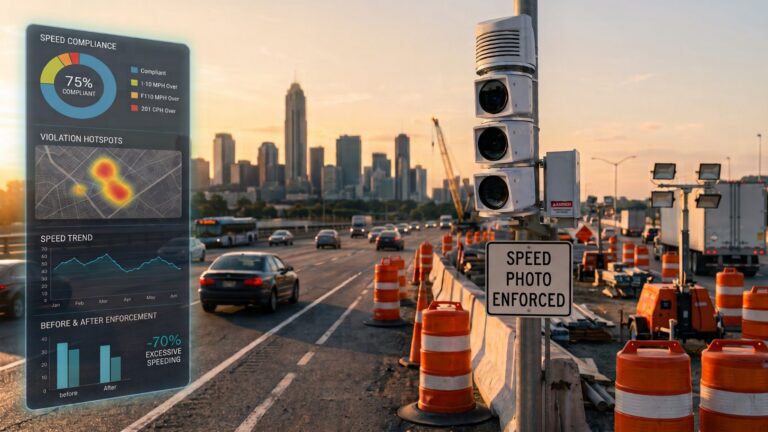
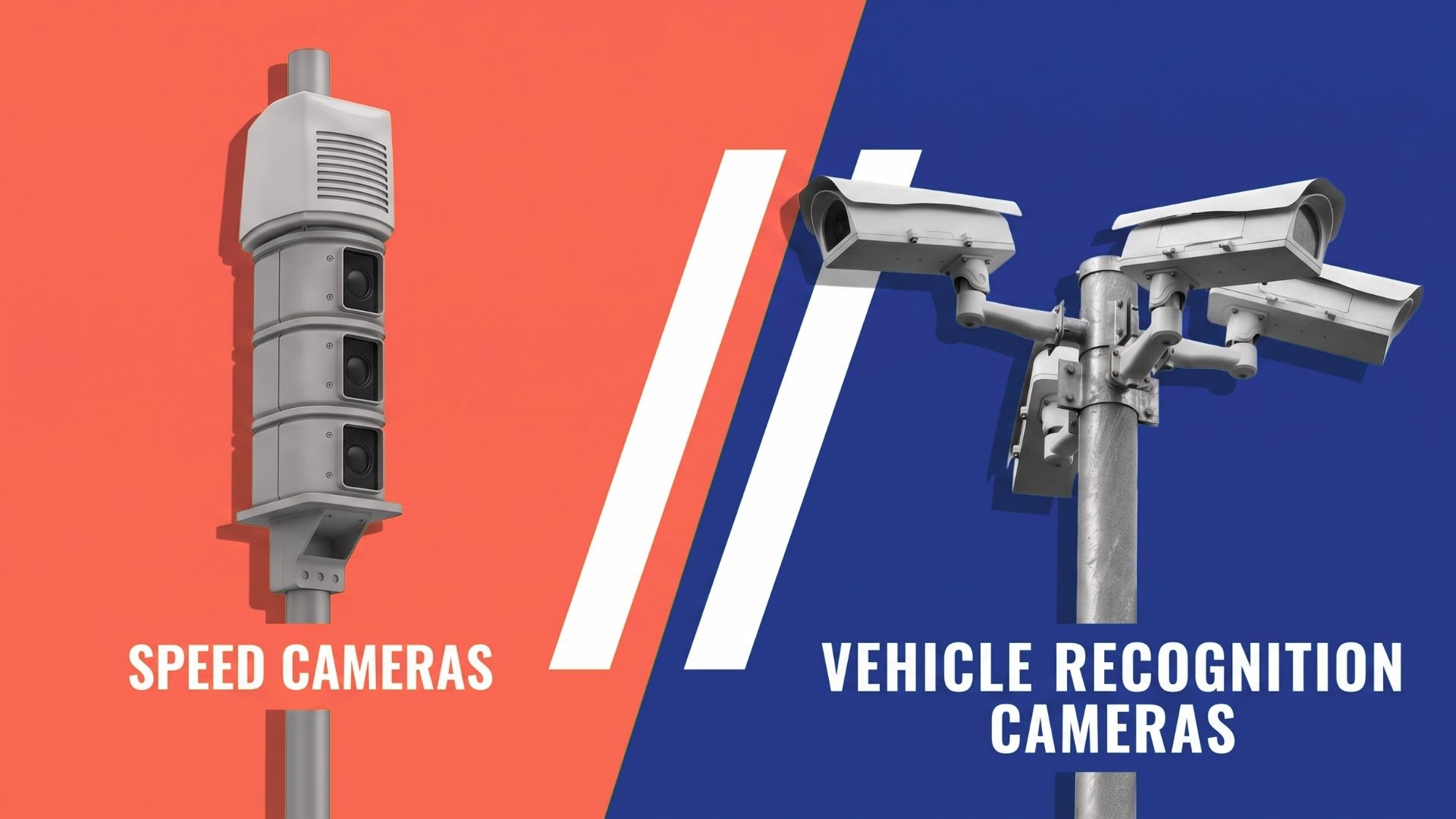
A wave of communities has spent the past year pushing back against automated license plate readers (ALPR), and the concern is legitimate: cameras that photograph every passing vehicle and log its location can build a detailed record of where people go. But that architecture is distinct from how automated traffic enforcement works. A speed or red-light camera captures a plate at the moment a specific law is broken, at one fixed location, and keeps nothing on the drivers who obey the limit. The distinction is not a matter of policy promises. It is built into how the systems are designed.
Download our fact sheet for a quick look at the key differences.
Two technologies, two purposes
The public conversation has started to blur these systems together, and it is worth separating them cleanly. A investigation-oriented ALPR network is designed to answer the question “where has this vehicle been?” To do that, it has to read and store data on every vehicle that passes, whether or not the driver has done anything wrong. Those records—plate, time, location, vehicle make, model and color—accumulate into a searchable history of ordinary movement.
Automated traffic enforcement answers a narrower question: “Did a violation just occur here?” The camera is triggered by a measured event: a vehicle exceeding the posted speed limit, or entering an intersection after the light turns red. Only then is an image captured. There is no rolling log of compliant drivers, because compliant drivers never generate a record in the first place.
Independent voices have made the same point. In its coverage of California’s speed-safety program, Streetsblog argued that speed cameras and ALPR networks differ at the level of architecture, not merely intent: enforcement cameras don’t track movements, don’t use facial recognition, and don’t build databases of where a person has been.
Law enforcement leaders are drawing the same line. At an August 2026 briefing by the Connecticut Police Chiefs Association—convened as the state tightened its plate-reader rules under a new law taking effect October 1—the chiefs stressed that automated license plate readers and traffic-safety cameras are, in their words, separate issues that shouldn’t be conflated. Their point is telling: even the officials who rely on ALPR for investigations are careful to distinguish it from violation-triggered enforcement, because the two technologies raise different questions and deserve different rules.
Why the design difference matters for privacy
Most of the recent litigation and community opposition around ALPR turns on three things: indiscriminate collection, long or indefinite retention, and broad data sharing across agencies. The Brennan Center has noted that ALPR systems collect data on every passing car regardless of any connection to a crime, and that the vast majority of scans capture drivers suspected of nothing at all. That is the mosaic problem: enough ordinary data points, held long enough, reveal an intimate picture of a person’s life.
A well-run enforcement program inverts each of those risk factors:
Collection is not indiscriminate. A record exists when a specific, measurable violation triggers it. The overwhelming majority of drivers passing a camera generate no data at all.
Retention is tied to a citation, not a person. Evidence is held only as long as an individual case requires, then purged on a defined schedule—not accumulated into a movement history. It is worth noting that the tightest ALPR retention laws now emerging are, in effect, trying to solve a collection problem that automated enforcement avoids from the outset. Connecticut’s new plate-reader law, for example, imposes a 21-day deletion window because ALPR sweeps up data on everyone; enforcement systems don’t generate that pool of innocent-driver records in the first place.
Access is limited and auditable. Responsible vendors restrict who can view images and personal data, and log every access. This is the safeguard the ACLU and others have found missing in the ALPR deployments now drawing the most criticism.
A legislative moment that rewards getting it right
States are actively drawing these lines in statute. California’s speed-safety framework was written specifically to separate enforcement from surveillance—building in retention limits, public oversight, equity protections, and a requirement that revenue fund safety improvements. Connecticut has moved in parallel on the investigation side, enacting one of the country’s more comprehensive plate-reader laws to govern retention, sharing, and access.
What’s happening in Connecticut right now proves the point precisely because the debate there has, at times, swept enforcement cameras and ALPR into a single controversy. That conflation is understandable—they look fairly alike on a pole—but it obscures the difference Connecticut’s chiefs themselves drew. For jurisdictions weighing their first program, the takeaway is not to retreat from proven safety tools, but to make the distinction legible from day one: show the public what is collected, when, and for how long.
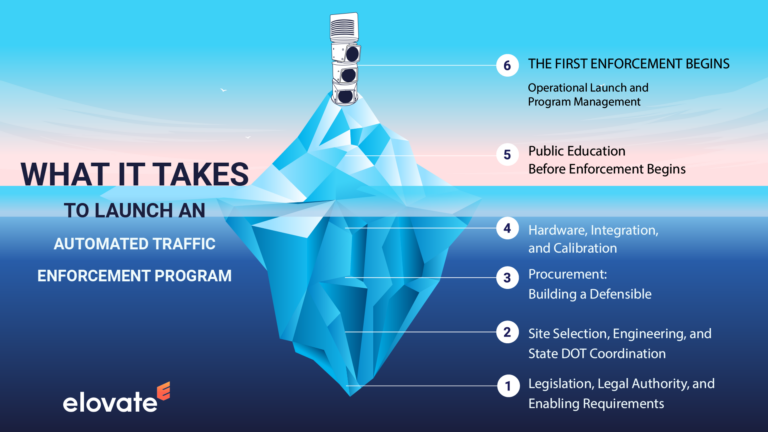
For jurisdictions evaluating automated enforcement for the first time, this is the useful lesson from the ALPR backlash: the programs that endure are the ones that can demonstrate, on paper and in their architecture, that they collect the minimum necessary data, keep it only as long as a case requires, and can prove who touched the data. Communities exploring their first program can design those protections in from the start rather than retrofitting them under pressure later.
Why this matters
The backlash against mass license-plate surveillance is a signal worth reading carefully, not a reason to abandon proven road-safety tools. Automated enforcement earns public trust precisely because it is built to do one thing—reduce dangerous driving at a known location—and to leave everyone else’s movements unrecorded. As more states move to authorize these programs, the jurisdictions that treat privacy-by-design and safety as the same commitment will be the ones whose programs last.
Frequently asked questions
No. A speed or red-light camera captures an image when a vehicle commits a specific violation at that location. Drivers who obey the law generate no record, so the system cannot assemble a history of anyone’s movements the way a surveillance ALPR network can.
Enforcement evidence is retained only as long as an individual citation requires, then purged on a defined schedule. Because a record is created only when a violation occurs, there is no standing pool of data on compliant drivers—the concern that retention laws like Connecticut’s 21-day rule are designed to address for ALPR.
No. They share camera hardware but differ in purpose and architecture. A Vehicle recognition camera reads and stores every passing plate to track movement; automated enforcement records violations, at fixed sites, with retention and access tied to the citation.