As our cities move ever faster toward smart mobility, automated traffic enforcement (ATE) systems need to evolve not just in deployment but in mindset. It is no longer sufficient to place a speed camera and leave it; jurisdictions face complex and shifting patterns in school zones, work zones and high‑crash corridors. At the same time, innovations in AI, connectivity and vehicle autonomy are coming into play. The question becomes: how do enforcement systems adapt, remain fair and transparent, and prepare for the future?
Pain Points in Key Enforcement Zones
School zones remain a persistent safety challenge. Studies show that vehicle speeds, congestion, and pedestrian interactions and distractions combine in these areas, creating higher risk. For example, a recent evaluation of school‑zone traffic control found both speed and pedestrian operations to be major issues. Traditional enforcement is resource‑intensive, and jurisdictions struggle with staffing, variable driver behavior, and managing enforcement when children are present and when they are not.
Work zones present another set of evolving difficulties. Work zones typically involve changed traffic patterns, lane shifts, temporary signage and a mix of vehicles — including heavy equipment, delivery trucks, and regular traffic. A recent article explains that AI and connected vehicle data have the potential to spot anomalies and improve safety in work zones, but so far deployment challenges remain. Research also suggests that when automated vehicles with Level 2/3 automation pass through work zones, the safety implications are complex: disengagement or hand‑over situations may elevate risk.
High‑crash corridors also require adaptive enforcement. These are locations where traffic flows are heavy, speeds oscillate, and emerging mobility modes (cycling, micromobility) add complexity. Automated enforcement systems have a role, but they must align to current, as well as future patterns, not simply replicate historic crash data. A systematic review of automated enforcement systems shows they improve traffic management efficiency, but only when implementation is well matched to context.
Driving Innovation: AI, Connectivity & the Future of Mobility
To respond to such complex zones, ATE systems must pivot toward innovation. AI‐driven enforcement and analytics are accelerating. The adoption of machine learning, real‑time analytics and video/LiDAR‑based detection is transforming traffic enforcement. Trends in automated speed enforcement indicate that AI can enhance accuracy in detecting violations like speeding, illegal phone‑use, and non‑compliance in real time. In work zones, AI algorithms and connected vehicle data are being explored to anticipate incidents, manage merging and alert drivers to changing conditions.
Connected and automated vehicle (C/AV) integration is also key. Cities and regulators are moving toward frameworks to manage connected and automated vehicles. For example, Transport Canada’s Safety Framework for Connected and Automated Vehicles sets out principles and oversight for vehicles that will increasingly drive themselves or interface with infrastructure. As AVs become more present on roads, enforcement systems will need to adapt to mixed drivers, humans and machines, including how violations or non‑compliance are detected, how algorithms identify risk and how system behavior evolves.
Smart mobility is reshaping how cities move. The mobility ecosystem now includes micromobility, ride‑hailing, delivery vehicles, and changing peak flows. These shifts challenge existing and rigid enforcement strategies. For example, an ATE system designed only around historical car speeds will struggle to account for decreasing flows of cars in one lane but surging delivery truck traffic in another. Future enforcement needs to be dynamic.
A Blueprint for Future‑Oriented Enforcement
To align ATE systems with tomorrow’s mobility landscape, city and jurisdiction planners should consider a forward‐looking framework.
The first step is dynamic risk mapping. Rather than relying solely on historic crash data, jurisdictions must integrate real‑time feeds such as live data from connected cars, networks of traffic sensors and roadside analytics, to identify emerging hotspots such as a school zone with increasing micromobility activity or a work zone with unpredictable traffic flows.
Second, AI-powered systems can adjust enforcement based on the time of day, type of vehicle, and how the area is used — for example, whether it’s a school zone, residential street, or commercial area. These models enable ATE cameras and sensors to activate or relocate based on dynamic conditions, ensuring enforcement aligns with actual risk.
Third, systems must be ready for mixed‑traffic environments. As AVs increasingly share roads with human drivers, enforcement will need to detect disengagements, non‑compliance and interactions between vehicle types. New rules may be needed to determine how violations are assigned when algorithms fail or human intervention is required.
Fourth, fairness and transparency must be built into every layer of the system. Public communication about how AI is used, where cameras are placed, how data is processed, and how enforcement decisions are made will be vital to public trust.
Finally, enforcement data should feed back into infrastructure. When ATE systems identify patterns such as excessive speed in school zones, repeated lane violations in work zones — that data should guide redesigns, from signal timing to placement changes, helping to close the loop between enforcement and engineering.
Looking Ahead: The Future of Enforcement Technology
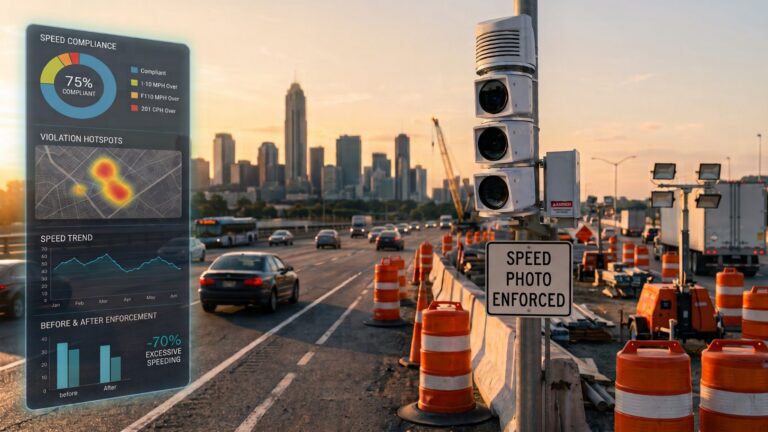
In the near future, enforcement will need to be smarter, more responsive, and fully embedded in the traffic ecosystem. Cities could deploy real‑time dashboards that alert when school zone violations spike, triggering dynamic enforcement and messaging. Work zone systems might integrate with connected vehicles to predict risks and guide temporary signage. AVs may be required to self‑report compliance, with ATE systems auditing behavior for transparency. Predictive models could reassign enforcement zones ahead of rush hour or after special events, rather than waiting for crashes to justify deployment.
The evolution ahead demands that Automated Traffic Enforcement evolves from static surveillance tools to dynamic safety platforms. They must anticipate and adapt, not just detect and penalize. ATE systems, when built on a foundation of AI, connectivity, fairness and infrastructure integration, become part of the city’s intelligence network rather than a static set of cameras. From school zones to work zones to high‑crash corridors, enforcement is shifting from reactive to proactive, from human‑only processes to machine‑enabled, and from standalone to integrated. Cities that embrace this future will not only enforce more effectively but will build safer, fairer, and more intelligent mobility systems.